Slams vs H2H: What Truly Defines Tennis's GOAT Status?
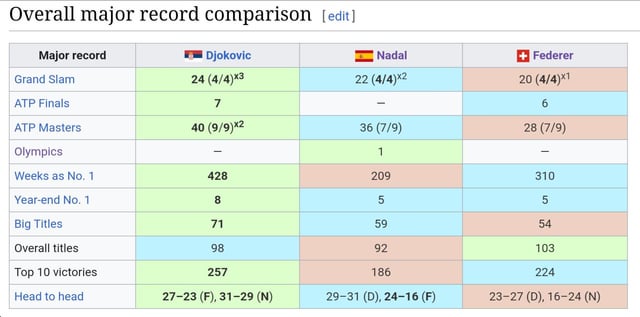
The quest to crown the "Greatest of All Time" (GOAT) in tennis is a perennial discussion, a fascinating débat GOAT tennis that captivates fans, pundits, and players alike. For decades, the metric of choice was clear: Grand Slam titles. The player with the most majors traditionally held the strongest claim to the throne. Yet, as the sport has evolved, and particularly with the unprecedented era of the 'Big Three' – Roger Federer, Rafael Nadal, and Novak Djokovic – new, equally compelling arguments have emerged. Chief among these is the head-to-head (H2H) record, sparking intense debate: Do Grand Slam victories alone suffice, or does dominance over one's fiercest rivals truly cement GOAT status?
The Enduring Power of the Grand Slam Count
Grand Slams – the Australian Open, French Open, Wimbledon, and US Open – are universally acknowledged as the pinnacle of professional tennis. Winning one requires a grueling two weeks of consistent, top-tier performance against the world's best. To win multiple, let alone achieve double-digit Slam counts, speaks to an unparalleled blend of skill, endurance, and mental fortitude. Historically, the player with the most major titles has been the default GOAT contender.
Roger Federer, for instance, held the record for the most men's singles Grand Slam titles for a significant period, a feat that, for many, made his GOAT status indisputable. His elegant, almost balletic game, coupled with his remarkable consistency on all surfaces (barring the clay courts of Roland Garros during Nadal's reign), seemed to solidify his claim. The sheer number of majors won represented a tangible, objective measure of success against the toughest competition year after year. For a long time, the narrative was simple: if you want to know who the GOAT is, just count the Slams.
However, this perspective often overlooks the evolving landscape of tennis itself. Comparing eras, such as the amateur and early Open Era days of Rod Laver, with the hyper-professional, physically demanding game played today, can be problematic. Modern tennis features deeper draws, more specialized athletes, and an intensity that makes sustained dominance incredibly challenging. Thus, while the number of Slams remains a crucial benchmark, some argue it's not the sole determinant, especially when considering the unique rivalries of the modern era.
The H2H Conundrum: When Direct Encounters Challenge the Narrative
While Slams measure overall tournament success, the head-to-head record offers a direct, unequivocal gauge of superiority between specific players. This is where the débat GOAT tennis gets particularly intricate. For someone to be considered the greatest ever, shouldn't they consistently defeat their closest competitors? This question gains immense weight when examining the iconic rivalry between Roger Federer and Rafael Nadal.
Despite Federer's initial lead in Grand Slam titles, his significantly disadvantageous H2H record against Nadal – particularly on clay, but also in many high-stakes matches – presented a glaring challenge to his undisputed GOAT claim. Nadal's dominance over Federer, especially in their prime, led many to question how Federer could be the "greatest of all time" if he frequently came up short against the very best player of his generation. Nadal's almost mythical aura on clay, where he achieved an unparalleled winning streak, made him seem "unbeatable" to many, echoing the feeling of Federer's early reign.
The H2H record isn't just about raw numbers; it speaks to a player's ability to impose their game, exploit weaknesses, and maintain a psychological edge over their rivals. In an individual sport like tennis, where mental resilience is paramount, repeatedly coming out on top against a specific opponent can be seen as a profound indicator of greatness. For more insights into this specific rivalry, you can explore Federer vs Nadal: Unpacking Tennis's Endless GOAT Debate.
Beyond the Numbers: The Intangibles of GOAT Status
While Slams and H2H records offer objective data points, the GOAT debate also involves subjective elements and other significant achievements that contribute to a player's overall legacy. These intangibles add depth and complexity to the discussion, ensuring that no single metric provides a complete picture.
- Dominance on Surfaces: While Nadal's unprecedented success on clay is legendary, Federer's mastery across grass, hard courts, and even indoor hard courts showcases a different kind of versatility. Djokovic's late-career consistency across all surfaces further complicates this.
- Weeks at World No. 1: Sustaining the top ranking for extended periods, as all members of the Big Three have done, reflects incredible consistency and year-long dominance, not just peak performance at majors.
- Masters 1000 Titles: These mandatory tournaments, just below the Grand Slams in prestige, are crucial indicators of sustained excellence throughout the season.
- Year-End Championships: Winning the ATP Finals, which pits the top eight players against each other, is another significant achievement.
- Aesthetic Appeal and Impact: Federer's fluid, elegant style of play has often been lauded as the most aesthetically pleasing in history. His grace on court and 'cat-like' movement, combined with that 'liquid whip forehand,' captivated millions, transcending mere results. This kind of impact, attracting new fans and elevating the sport's artistry, is an intangible that some weigh heavily.
- Longevity and Resilience: The ability to remain at the peak of the sport for over a decade, adapting their games and overcoming injuries, is a testament to the incredible dedication and talent of these athletes.
Navigating the "Débat GOAT Tennis": A Holistic Perspective
Ultimately, there is no single, universally agreed-upon answer to the GOAT question, and perhaps there never will be. The ongoing débat GOAT tennis is part of what makes the sport so engaging. Each argument – whether centered on the sheer volume of Grand Slams, the psychological edge reflected in the H2H, or the broader impact on the game – holds valid points.
To truly appreciate the greatness of these players, it's essential to consider a holistic view. Instead of fixating on one statistic, fans and analysts increasingly look at a combination of factors: Grand Slam titles, head-to-head records against top rivals, overall titles, weeks at No. 1, and the sheer impact and legacy each player leaves on the sport. The very fact that multiple players can lay a credible claim to the GOAT title within the same generation speaks volumes about the incredible era of tennis we have witnessed.
The beauty of tennis lies not just in its definitive winners and losers, but in the compelling narratives woven by its legends. While the numbers provide a framework, the emotional connection, the memories of specific matches, and the sheer artistry displayed on court often influence individual perceptions of greatness. For a deeper dive into how different achievements stack up, consider reading Can Nadal Catch Federer? Reconsidering Tennis's GOAT Status.
Conclusion
The discussion of "Slams vs H2H" in the GOAT debate is a testament to the complexity and richness of modern tennis. While Grand Slam titles serve as a powerful foundation for any GOAT claim, the head-to-head record provides a critical lens into direct competitive dominance. Adding to this, the myriad of other achievements and intangible qualities ensures that the "Greatest of All Time" remains a moving target, an evolving conversation rather than a fixed pronouncement. For many, Roger Federer will always be the epitome of aesthetic brilliance, while Rafael Nadal embodies an almost invincible fighting spirit, and Novak Djokovic represents unparalleled all-court consistency and statistical dominance. In the end, perhaps the true GOAT isn't a single player, but the collective era defined by these extraordinary athletes who continually push the boundaries of what's possible in the sport.